There is no shortage of organizations that list collaboration as a core competency. What is far rarer is a team that can actually collaborate under pressure, when the stakes are real, the information is incomplete, and the pace of work leaves little room for deliberation. The difference between teams that talk about collaboration and teams that practice it shows up most clearly in those moments. And the gap between the two is rarely closed by a workshop that describes what good collaboration looks like.
Collaboration at its best involves a specific set of behaviors working in concert. Clear communication that keeps everyone oriented to the same goal. The ability to influence without authority, to bring people along through trust and shared purpose rather than position or mandate. Active listening that creates space for the full range of perspectives on a team. And a willingness to stay connected and adaptive when conditions shift. These behaviors are learnable, but they are developed through experience, not instruction. They require practice in situations that demand performance. Just like music.
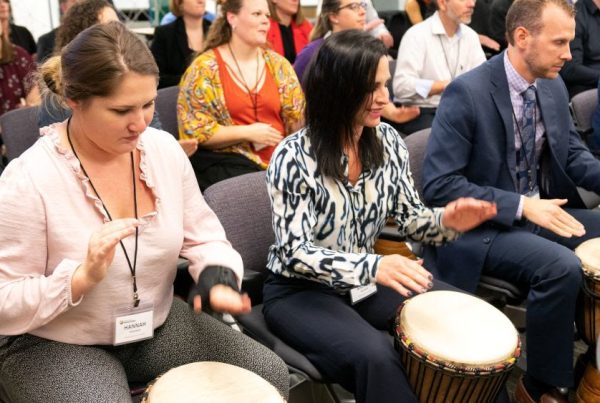
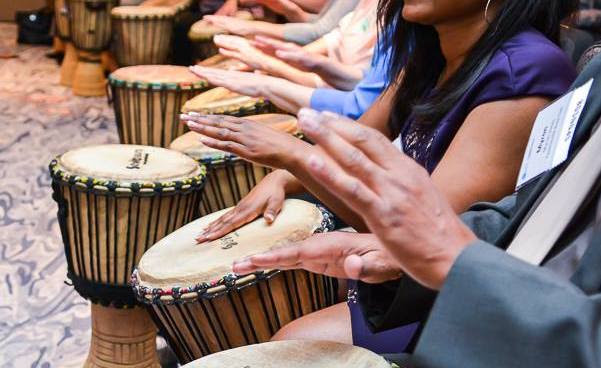
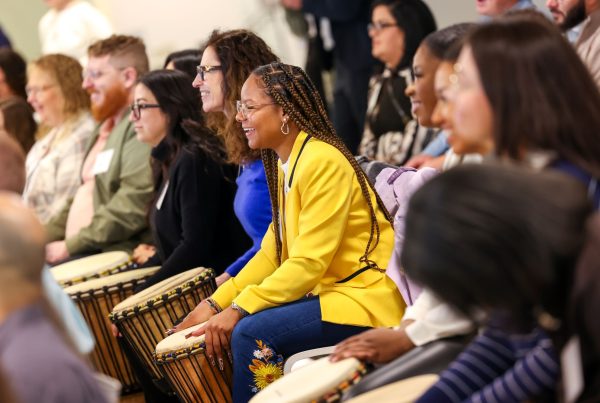
A drum ensemble is one of the most direct environments for developing collaboration. In music, collaboration is not a concept. It is a requirement. Every player must listen actively, contribute their part with precision, and stay oriented to the group rather than their individual performance. Influence in a drum ensemble does not come from authority. It comes from presence, timing, and the trust the group has built in each player’s commitment to the shared rhythm. When a transition comes or the tempo shifts, the ensemble does not stop to discuss. It listens, adjusts, and moves together. That experience of real-time collaboration, where every person’s contribution is visible and the group’s success depends on collective attentiveness, transfers directly to how teams work together when the pressure is on.
What participants carry back is a felt sense of what genuine collaboration requires and what it makes possible. They have experienced the difference between working side by side and actually working together. They know what it feels like when a group is truly aligned, and they have practiced the behaviors that create that alignment. In organizations where collaboration is expected but rarely developed, that kind of shared experience is one of the most practical investments a leader can make.
Are you looking for a way to engage your team with experiential learning? We help organizations meet their goals through experiential training programs that leverage the power of group drumming. Get in touch with us at connect@sewabeatsusa.com or 1-800-273-1465.