
Every leader knows the feeling: a full calendar, a longer list than the day allows, and the persistent sense that the most important work keeps getting pushed. The instinct is to manage time better, to find a system, a tool, or a framework that finally brings order to the chaos. But the challenge most leaders are facing is not a scheduling problem. It is a focus and clarity problem. Without a clear and shared sense of what actually matters most, teams default to urgency, and urgency has a way of crowding out everything that is truly important.
Focus and prioritization are leadership skills before they are personal habits. A leader who cannot articulate what the team should be working on this week, this quarter, and why, leaves their people to make those judgments on their own. Some will get it right. Others will spend their energy on the wrong things entirely, not because they are not working hard, but because no one gave them a clear signal about where that effort should go. The ability to cut through competing demands, name what matters, and protect the conditions for deep and meaningful work is one of the most practical and undervalued things a leader can do for their team.
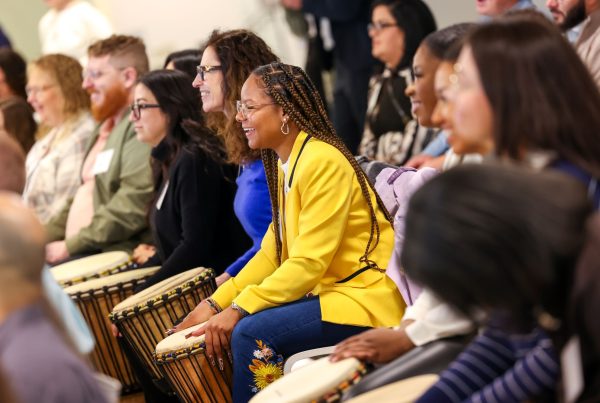
In a drum ensemble, focus is not optional and prioritization happens in real time. Every player must decide, moment to moment, what to listen to, what to hold, and what to let go. When the rhythm is complex and the group is large, the temptation is to try to hear everything at once. Players quickly learn that this leads to confusion rather than coherence. The skill is learning to lock in on what matters most, your part, the shared pulse, the players around you, and to let the rest find its place. That is not multitasking. It is disciplined attention, and it produces something far more powerful than effort spread thin across everything at once.
What participants take back to work is a practiced understanding of what focused attention actually feels like and what it makes possible. They have experienced the difference between a group that is busy and a group that is locked in. They know what it sounds like when everyone is clear on their part and committed to the shared goal. And they carry a physical memory of what happens when a team stops reacting to everything and starts directing its energy toward what matters most. In organizations where distraction is the default and urgency often masquerades as importance, that kind of practiced focus is a genuine competitive advantage.
Are you looking for a way to engage your team with experiential learning? We help organizations meet their goals through experiential training programs that leverage the power of group drumming. Get in touch with us at connect@sewabeatsusa.com or 1-800-273-1465.